Recording complete. Airing now.
Have you ever heard of Voice Confrontation? Or Acute Autophonia? My son who works in the media production industry tried to explain to me why a person does not like the sound of their own voice. Apparently we are used to hearing ourselves from within. In true fashion, my son digs deeper in his explanation.
Colton texts me, “We hear the vocal tissue in our neck and lower head become conducted through the bone of our skull, and by hearing it out loud on a recording we are met with an audibly unfamiliar version of ourselves.”
Who needs A.I. when I have a son who is happy to simplify complicated matters for me? He is also my go to for Tech Support, after which I always stay on the line for the survey to give him five stars.
My follow up question in the text thread with Colton, “Is the sound of my voice on this recording the same as what others hear?”
I love his response.
“Yep! But it’s never as bad as we ‘think’! That odd feeling, or aversion to it, is only because it is incongruent with what we expect to hear. In other words: our brain EXPECTS to hear that ‘internal voice’ but because it doesn’t, we get a weird ‘feeling’ about it. But it’s totally normal!”
His explanation reassures me that my self consciousness about the sound of my voice is all in my head. Literally. I love his use of exclamation points. His excitement is evident. It is fun when our creative worlds intersect, and when the son is educating the mother. We have many conversations like this one. Some of which are recorded on mic. A curiosity seed I will leave here for now…
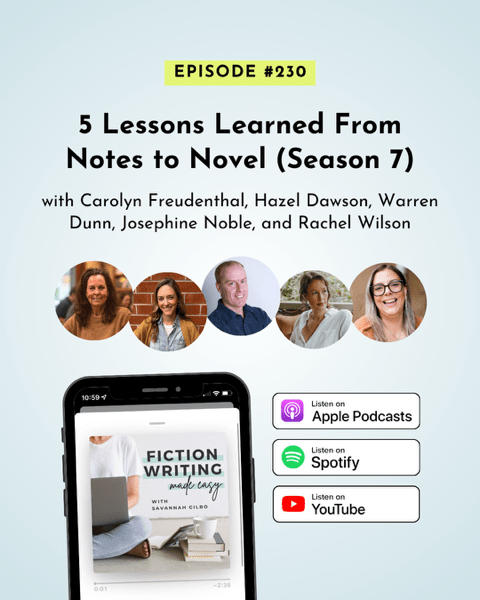
Today my blog post is about a Podcast episode that I had the privilege and honor to take part in. After taking a writing course online called, Notes to Novel with Savannah Gilbo. Last fall, she asked for volunteers to record feedback on take-aways. From those, she chose five to feature on an episode of her podcast Fiction Writing Made Easy with Savannah Gilbo. I recorded my four minute clip back in November. What I said then stands true today. The Notes to Novel class helped me with planning in my writing journey.
Late last August, I had received several rejections from agents I was querying. The query letter is where the pitch of your story needs to hook the agent (or assistant of the agent) who is weeding through a hefty inbox of writers querying for representation. Your email needs to grab their attention enough for them to even scroll down to the sample five or ten pages. For those not familiar with query letters, agents want to know where it will sit on the shelf in a book store or library (the comp titles), the genre, wordcount, and simply–who, what problem, what’s standing in the way, and what happens if the problem isn’t resolved. They are looking for the books they can pitch to publishers. It takes mere seconds for an agent to pass, and move to the next query email. I sent out five. I got five rejections within two months. (I know, that’s barely scratching the surface).
I sent my query letter to a Substacker (with great articles) who is in the circle of literary agents educating aspiring writers (for a small fee). She gave me feedback on my query package. On a positive note, she said my writing sample was strong–clear voice, tone, and craft. Within the ten pages I had properly grounded the reader and engaged them to turn the pages. As for my query letter, the summary needed work.
Among other things, she said, “When revising, think of what Clara’s goals are. What does she want and need? Who or what is stopping that from happening? What does she stand to lose if she fails to reach her goals? Something important that she cannot walk away from must be at stake.”
I sat with this feedback. I took the dogs on a walk. I put in my earbuds and listened to one of the four writing podcasts I tune into each week. See my Writer’s Desk page of this website for my favorites. On this dog walk, it was Fiction Writing Made Easy with Savannah Gilbo.
At the end of Savannah’s podcast about character arcs or worldbuilding, she mentioned the upcoming Notes to Novel class. The window of signing up was closing soon. I listened to several writers share their growth from taking the 8 week class. It was a sign. The timing of me taking a walk, feeling a little discouraged about my plot lacking stakes, and then hearing this episode.
My journey into writing has been through the backdoor. I studied to be an elementary school teacher. I did not get an MFA. I came into writing through the little plastic door of the Fisher Price playhouse. My imagination and story creation began as a little girl stretched out on my stomach voicing characters on the tiny wooden people in my hands. My mother read to us before bed, in doctor waiting rooms, and on visits to the library. My sisters and I played “library” in the living room with the old leather books and the set of Encyclopedia Britannica.
Did I ever imagine I would be attempting to have a book of mine on a shelf one day?
At that age, I think my fantasy was more about living in the made up world of characters I was creating. The situations with tension and stakes I invented for my wooden Little People. Fast forward a few decades, after teaching in a classroom and raising four children, I have come to love writing as much as I love reading.
I set down the dog leashes, grabbed my laptop and signed up for Savannah’s Notes to Novel class. I liked the idea of approaching a novel from the ground up, step by step, through course modules, weekly live meetings, and feedback. I set Clara (my first manuscript) aside. I began with a new character with different issues. Meg and the world-building around her would be my focus for the next few months.
As you can hear from my take-aways in the podcast, I learned to become more of a plotter than a pantser in my writing, working through my overarching theme, the character goals, and more. By the end of the class I had the outline of the forty scenes mapped out on colored index cards stuck to the wall in my office. For an unlimited time, I also have access to the materials and modules from Savannah.
A bigger take-away than I had realized when I recorded myself in November, was confidence. Deciding to take a shot at writing a book is not like trying to make sourdough bread when someone hands you a mason jar of starter. The bread can end up stodgy and nobody will know. But putting yourself out there as a writer, your thoughts crafted with your own words…that is scary. Imposter syndrome is real. The antidote is surrounding yourself with other writers who share the dream.
In almost every writing course I have taken online, being in the company of other writers helps me get over my fears. The chats are filled with writers offering praise or suggestions, sharing their handles and seeking community. Some classes have small break out sessions where we introduce ourselves and our work in progress. Beta reading groups and accountability partners
are formed. After gaining much more than I had expected from Notes to Novel, I am happy to promote this writing resource.
As hard as it is to hear my own voice on this recording, because of “Acute Autophonia,” it is exciting to be featured on my first podcast. If I can ever get over the weird sound of my voice, I hope there will be more podcast appearances in the future!
I almost forgot! Here is the link to the podcast I am on: https://www.buzzsprout.com/791087/episodes/18510345


Leave a reply to Janet Cancel reply